Architecture
The Decision Intelligence Runtime (dir-core) introduces a robust architectural pattern tailored for AI governance. This pattern enforces predictability, determinism, and safety while allowing seamless integration with modern generative models.
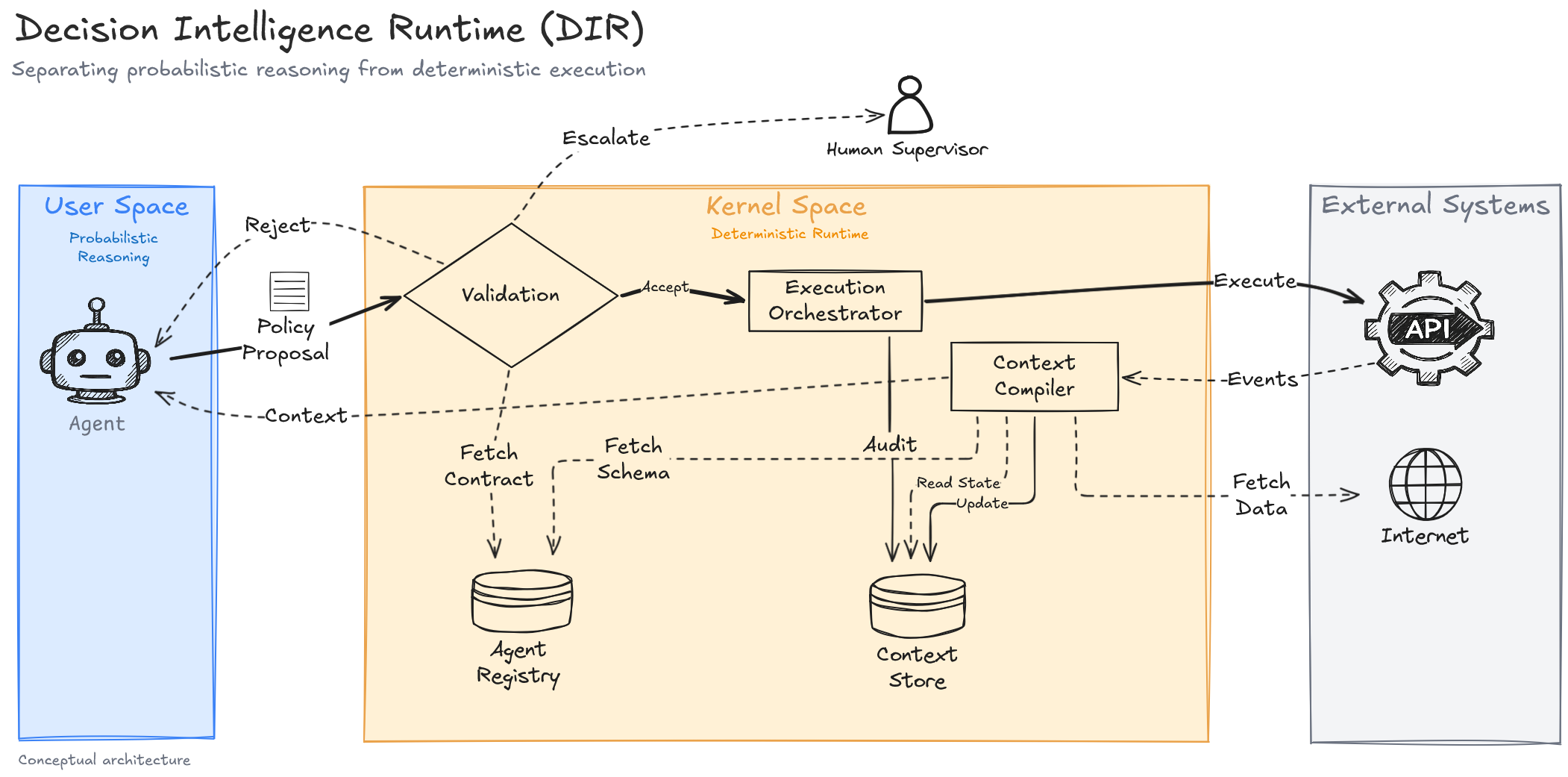
"The Wall": A Strict Separation of Concerns
At the core of dir-core is a conceptual boundary called The Wall. It separates the unpredictable nature of AI from the deterministic mechanics of application infrastructure.
1. User Space (Probabilistic AI)
- Role: Creativity, reasoning, analyzing context, processing natural language, planning.
- Tools: LangChain, CrewAI, Autogen, OpenAI, Anthropic, Ollama, Gemini.
- Output: Generates a
PolicyProposal—an unverified Claim of what the agent intends to do. - Constraints: Agents in User Space are completely isolated. They have zero credentials, cannot access production databases, and are incapable of dispatching real-world API requests (like transferring funds or spinning up servers).
2. Kernel Space (Deterministic Runtime)
- Role: Validation, enforcement, traceability, and execution.
- Tools:
dir-core, the Decision Integrity Module (DIM), Context Compiler, Idempotency Guard. - Input: Consumes a
PolicyProposaland evaluates it against formalResponsibilityContracts. - Output: If accepted, transforms the Claim into an
ExecutionIntent(a Fact)—which is then safely dispatched to infrastructure layers. - Constraints: The Kernel Space contains no AI. It relies strictly on boolean arithmetic, regular expressions, JSON schemas, cryptographic hashing, and hard-coded business rules.
Hexagonal Architecture
dir-core leverages Hexagonal Architecture (Ports and Adapters). It places the deterministic Kernel at the center and uses abstract interfaces (Ports) to interact with the outside world (Adapters).
graph TD
    subgraph "External Adapters"
        SQL[PostgreSQL Adapter]
        YAML[YAML Contract Loader]
        OLL[Ollama LLM Client]
    end

    subgraph "dir-core (Kernel Space)"
        DIM[Decision Integrity Module]
        REG[Agent Registry]
        STORE[Context Store]

        DIM --> REG
        DIM --> STORE
    end

    SQL -.->|Implements ContextStorage| STORE
    YAML -.->|Implements ContractProvider| REG
    OLL -.->|Implements LLMClient| Agent[User Space Agent]
Dependency Inversion
In a standard AI application, an agent typically interacts directly with a database or an external API.
In dir-core, this flow is inverted:
1. The Application defines technical implementations for logging, LLMs, Storage, and Contracts (Adapters).
2. The Application injects these Adapters into dir-core Components (Ports).
3. The Application initiates a DecisionFlow.
Because dir-core only defines interfaces (like LLMClient or AgentRegistryStorage), it remains technology-agnostic. It doesn't matter if your contracts are stored in a Git repository, a relational database, or an Open Policy Agent (OPA) server. As long as you provide an Adapter that fulfills the expected Interface, dir-core will enforce the rules.
The DecisionFlow Lifecycle
Every decision in dir-core follows a rigorous lifecycle tracked by a globally unique DFID (DecisionFlow ID).
- Trigger: An event occurs (e.g., market price changes, a user submits a refund request).
- Context Compilation: The Runtime gathers a deterministic snapshot of reality (
ContextSnapshot) and binds it cryptographically to the DFID. - Reasoning (User Space): The Agent evaluates the ContextSnapshot against its assigned
Missionand emits aPolicyProposal(a Claim). - Validation (Kernel Space): The DIM evaluates the Proposal against the Agent's
ResponsibilityContract(e.g., verifying limits likemax_refund_eurorallowed_environments). - Execution: Only validated Proposals are transformed into an
ExecutionIntent. - Audit: All actions, including rejections (
MISSION_DISSONANCE,STATE_DRIFT_ERROR), are logged immutably.